Featured Books
Medical Jurisprudence, Forensic medicine and Toxicology. Vol. 1 by R. A. Witthaus et al.
Always visible content "Medical Jurisprudence, Forensic Medicine and Toxicology. Vol. 1" by R. A. Witthaus et al. is a scientific publication written in the late 19th century. This comprehensive work serves as a fundamental reference for the intersection of medicine and law, particularly focusing on how medical knowledge applies in legal contexts. The book explores various aspects of medical jurisprudence, forensic medicine, and toxicology, aimed at practitioners in both legal and medical fields, as well Hidden checkbox to control the toggle Clickable label to show more The extra text that is initially hidden Clickable label to show less as scholars interested in legal medicine’s historical and practical significance. The opening of the volume sets the stage by delineating the key topics—medical jurisprudence, forensic medicine, and toxicology. It discusses the historical development of these fields, illustrating the evolution of the legal relationships between medical practitioners and the law. The introduction emphasizes the necessity for legal definitions regarding medical practice, the rights and duties of physicians, and the importance of providing expert testimony in legal cases. This section serves not only as an academic foundation but also as a practical guide for understanding the statutory landscape governing medical practice and its implications for both physicians and patients. (This is an automatically generated summary.)
Surgical Anatomy by Joseph Maclise
Always visible content "Surgical Anatomy" by Joseph Maclise is a scientific publication written in the mid-19th century. The work is primarily focused on the anatomy of the human body, particularly its relevance to surgery, emphasizing the relationship and relative positions of various anatomical structures. Through detailed illustrations, it aims to present vital anatomical information necessary for medical students and practitioners. At the start of the text, the author expresses gratitude to mentors and acknowledges the Hidden checkbox to control the toggle Clickable label to show more The extra text that is initially hidden Clickable label to show less contribution of previous scholars to the field of anatomy. The preface outlines the purpose of the work, stating a desire to provide readers with a practical understanding of anatomy that combines theoretical knowledge with surgical applications. Maclise emphasizes the importance of accurate anatomical knowledge for medical professionals, particularly in relation to surgical procedures and the intricacies of human anatomy, as revealed through dissections. The text promises a systematic study that integrates anatomical illustrations to enhance comprehension, making it a valuable resource for both students and practitioners in the medical field. (This is an automatically generated summary.)
The Mediæval Hospitals of England by Rotha Mary Clay
Always visible content "The Mediæval Hospitals of England" by Rotha Mary Clay is a historical account written in the early 20th century. This work explores the significance and role of hospitals in medieval England, serving as institutions of care and charity for the sick, the helpless, and wayfarers during a time when public health infrastructure was rudimentary. The author aims to shed light on how these hospitals were integral to the social fabric of the Hidden checkbox to control the toggle Clickable label to show more The extra text that is initially hidden Clickable label to show less Middle Ages, extending beyond mere medical assistance to embody a complete support system for the vulnerable populations. At the start of the narrative, the introduction outlines the vital yet underappreciated role that hospitals played throughout the medieval period. The author emphasizes that these institutions were not medical in nature, as modern readers might expect, but were largely ecclesiastical, focusing on spiritual care as well as physical sustenance for individuals in need. Various types of hospitals are pointed out, such as those for lepers, wayfarers, and the poor. Specific examples, like the establishment of the significant St. Bartholomew’s Hospital and St. Thomas’ in Canterbury, highlight the evolution of these hospitable refuges as they adapted to the changing societal needs of the time. This opening sets the stage for a deeper exploration into the complex histories and varying functions of medieval hospitals throughout England. (This is an automatically generated summary.)

The Medicinal Plants of the Philippines by T. H. Pardo de Tavera
Always visible content "The Medicinal Plants of the Philippines" by T. H. Pardo de Tavera is a scientific publication written in the late 19th century. This work provides a comprehensive exploration of the medicinal uses of various native plants found in the Philippines, along with their botanical descriptions and applications in traditional medicine. The book aims to document the rich therapeutic practices associated with Filipino flora, emphasizing the intersection of local knowledge and formal medical Hidden checkbox to control the toggle Clickable label to show more The extra text that is initially hidden Clickable label to show less science. The opening portion of the work includes a translator's preface and the author's preface, explaining the dedication to studying and documenting the medicinal plants of the Philippines based on both indigenous practices and scientific inquiries. Tavera shares his experiences collecting botanical specimens and notes that the text serves as a resource for medical professionals eager to understand tropical medicine better. The prefaces also highlight the importance of native therapeutics and the potential advantages of local plants over exotic alternatives in treating diseases, setting the stage for the detailed descriptions of medicinal species that follow in the text. (This is an automatically generated summary.)
Psychopathia sexualis: With especial reference to contrary sexual instinct
Always visible content "Psychopathia Sexualis: With Especial Reference to Contrary Sexual Instinct" by Dr. R. von Krafft-Ebing is a medico-legal study written in the late 19th century. This work delves into the complexities of human sexuality, with a particular focus on sexual pathologies, including sexual perversions and their implications for both individuals and society. It aims to establish a scientific foundation for understanding sexual deviations, exploring their psychological, physiological, and sociocultural dimensions. The opening of Hidden checkbox to control the toggle Clickable label to show more The extra text that is initially hidden Clickable label to show less the text sets the stage for a comprehensive examination of sexual instinct as a powerful motivator of human behavior, intertwining sexuality with ethical, artistic, and emotional aspects of life. Krafft-Ebing emphasizes the lack of scientific discourse regarding sexuality, critiquing previous philosophical treatments and arguing for a medically-informed exploration of sexual psychology. He draws attention to the importance of understanding sexual phenomena in a clinical context, acknowledging that misconceptions and societal taboos often complicate discussions about sexual deviance. The beginning presents a clear intention to address this gap in knowledge, making the work not only relevant to medical professionals but also vital for the legal understanding of sexual crimes. (This is an automatically generated summary.)

The Book of Household Management by Mrs. Beeton
Always visible content "The Book of Household Management" by Mrs. Beeton is an extensive guide to running a household in Victorian Britain, first published in 1861. Initially serialized in monthly installments beginning in 1859, this comprehensive work covers everything from cookery and household duties to medical advice and servant management. The book became an immediate bestseller, selling 60,000 copies in its first year and nearly two million by 1868. Its highly structured recipes and practical Hidden checkbox to control the toggle Clickable label to show more The extra text that is initially hidden Clickable label to show less instructions revolutionized domestic management, making it the most consulted cookery book between 1875 and 1914. (This is an automatically generated summary.)

The Great American Fraud by Samuel Hopkins Adams
Always visible content "The Great American Fraud" by Samuel Hopkins Adams is a series of articles on the patent medicine industry written in the early 20th century. The work critiques the fraudulent practices of patent medicine vendors and the detrimental effects these products have on public health, revealing the deceptive advertising and questionable efficacy of various remedies. It aims to raise awareness and advocate for reforms to protect consumers from harmful and misleading medical claims. Hidden checkbox to control the toggle Clickable label to show more The extra text that is initially hidden Clickable label to show less The opening of this exploration begins with a strong condemnation of the patent medicine industry, highlighting the astronomical sums of money spent by Americans on these dubious products each year. Adams sheds light on the reliance on alcohol, opiates, and other harmful ingredients disguised as cure-alls, emphasizing the industry's exploitation of gullible consumers who are misled by testimonials and aggressive marketing. He discusses specific examples of harmful remedies, including Peruna and Liquozone, outlining their composition and the false claims made by their promoters. The narrative sets the stage for further discussions on the mechanisms of deception and the urgent need for public awareness and legislative action against such fraudulent practices. (This is an automatically generated summary.)

Travels in Peru and India by Sir Clements R. Markham
Always visible content "Travels in Peru and India" by Sir Clements R. Markham is a historical account written in the mid-19th century. The book explores the journeys related to the collection and introduction of the Chinchona plants, which are vital for producing quinine, from South America to India. It delves into the botany, geography, and history surrounding the Chinchona trees, as well as the author’s travels in Peru and the cultivation efforts in India, highlighting Hidden checkbox to control the toggle Clickable label to show more The extra text that is initially hidden Clickable label to show less significant figures and events in the process. At the start of the narrative, Markham outlines the significance of Chinchona trees, initially discovering their medicinal qualities in Peru and their indispensable role in combating fevers. He describes his mission to collect the plants and seeds in South America, including arduous explorations into the uncharted forests, and introduces key contributors in the endeavor. The opening chapters reflect on the historical backdrop of the Peruvian officials’ efforts and the indigenous usage of the bark, setting the stage for a captivating exploration of both the travel experiences and the broader implications of Chinchona cultivation for medicine and trade. (This is an automatically generated summary.)
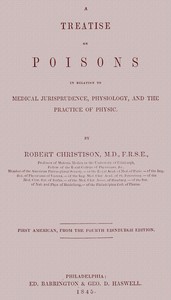
Treatise on Poisons by Sir Robert Christison
Always visible content "Treatise on Poisons" by Sir Robert Christison is a scientific publication written in the mid-19th century. This comprehensive work delves into the complex interactions of poisons within the body, examining their effects in relation to medical jurisprudence, physiology, and the practice of medicine. The text is likely aimed at medical professionals and students, providing detailed insights into various types of poisons and their physiological actions, alongside discussions of toxicology. At the start Hidden checkbox to control the toggle Clickable label to show more The extra text that is initially hidden Clickable label to show less of the treatise, the author outlines the scope and importance of toxicology in medicine. He discusses the modes in which poisons exert their effects, differentiating between local and remote actions. The beginning introduces fundamental concepts and terminology related to the physiological mechanisms by which poisons operate, emphasizing the impact they have not only at the site of contact but also on distant organs and systems within the body. Christison aims to lay a scientific foundation for understanding the effects of various poisons, which are explored in detail throughout the work. (This is an automatically generated summary.)