Featured Books

Mr. Honey's Large Business Dictionary (English-German)
"Mr Honey's Large Business Dictionary (English-German)" by Winfried Honig is a reference guide compiled in the early 21st century. This dictionary serves as a bilingual resource, featuring a comprehensive compilation of business-related phrases in both English and German, making it particularly useful for learners and professionals in the international business community. The opening of the dictionary introduces the purpose and background of the work, highlighting that Winfried Honig, affectionately referred to as Mr. Honey, began compiling this resource in the 1970s. The text emphasizes the author's goals of aiding students and professionals in understanding business language and supporting educational efforts to foster proficiency in English and German business communications. The initial parts also detail the dictionary's organization, noting its arrangement for ease of use by both English and German speakers, underscoring its aim to facilitate clear understanding across linguistic barriers in the business world. (This is an automatically generated summary.)
The reader's guide to the Encyclopaedia Britannica : A handbook containing…
Always visible content "The Reader’s Guide to the Encyclopaedia Britannica" is an educational resource written in the early 20th century. This handbook provides structured approaches to studying a vast range of topics covered in the Encyclopaedia Britannica, aiming to enhance readers' understanding and ability to use the materials effectively for both systematic study and casual reading. It serves as a bridge between the expansive knowledge contained in the Britannica and the reader's learning journey. The Hidden checkbox to control the toggle Clickable label to show more The extra text that is initially hidden Clickable label to show less opening of the guide outlines the book's purpose and practical applications, explaining how readers typically interact with the Encyclopaedia by searching for answers to specific queries rather than exploring it in depth. It emphasizes that the guide will help users engage with the Britannica more comprehensively, offering organized courses of reading that cover various subjects systematically. The introduction also touches on the vastness of the Encyclopaedia, highlighting its structure and the importance of understanding its articles as interconnected rather than isolated pieces of information. The guide sets the stage for subsequent chapters that will detail specific reading paths for professionals, children, women, and recreational interests, along with providing insights into modern issues and systematic fields of study. (This is an automatically generated summary.)

The Nuttall encyclopædia : being a concise and comprehensive dictionary of…
Always visible content "The Nuttall Encyclopædia" by P. Austin Nuttall is a concise encyclopedia first published in 1900. Named for Dr. Peter Austin Nuttall, this reference work contains over 16,000 brief articles covering history, biography, geography, literature, philosophy, religion, science, and art. The entries are notably short and often reflect a distinct British perspective on world events. While it includes fictional characters from Dickens, it curiously lacks entries for common subjects like fruit, revealing the Hidden checkbox to control the toggle Clickable label to show more The extra text that is initially hidden Clickable label to show less editor's selective worldview. (This is an automatically generated summary.)

A Concise Dictionary of Middle English from A.D. 1150 to 1580 by Mayhew and Skeat
Always visible content "A Concise Dictionary of Middle English from A.D. 1150 to 1580" by Rev. A. L. Mayhew and Rev. Walter W. Skeat is a linguistic reference work likely compiled in the late 19th century. The dictionary serves as a resource for scholars and students interested in Middle English, detailing the meanings and etymology of vocabulary from a critical period in the English language's development. The opening of this dictionary presents its objectives and Hidden checkbox to control the toggle Clickable label to show more The extra text that is initially hidden Clickable label to show less context, explaining the necessity for a concise reference to Middle-English words during a time when existing texts were incomplete. Professor Skeat outlines the distinct approach of this work, which focuses on more accessible sources and aims to represent the specific literary language of Chaucer and similar authors. The preface also highlights the challenges learners face in understanding the variations in spelling and pronunciation of Middle-English, thus setting the stage for the extensive glossary that follows, which organizes words alphabetically along with definitions and historical context. (This is an automatically generated summary.)

A Complete Guide to Heraldry by Arthur Charles Fox-Davies
Always visible content "A Complete Guide to Heraldry" by Arthur Charles Fox-Davies is a comprehensive reference work on the science of heraldry written in the early 20th century. This publication delves into the history, laws, and practices associated with coats of arms, including their origins, symbolism, and the functions of heralds. The guide is not merely historical but emphasizes the continuing relevance and application of heraldry in the modern era. The opening of the book Hidden checkbox to control the toggle Clickable label to show more The extra text that is initially hidden Clickable label to show less establishes an overview of armory and its distinctions from heraldry, explaining that armory concerns the symbolic imagery on heraldic devices while heraldry encompasses broader ceremonial and genealogical facets. Fox-Davies critiques the misconceptions surrounding armory, arguing that it is not a stagnant field confined to the past but a living discipline adapting to contemporary contexts. He asserts that while ancient practices influence it, the rules governing armory must evolve with societal changes, setting the stage for a thorough exploration of heraldic principles and their modern implications. (This is an automatically generated summary.)
Novo dicionário da língua portuguesa by Cândido de Figueiredo
Always visible content "Novo dicionário da língua portuguesa" by Cândido de Figueiredo is a Portuguese language dictionary published in 1899. First released by Livraria Editôra Tavares Cardoso & Irmão, this comprehensive reference work underwent twenty-five editions across nearly a century, passing through multiple publishers in Portugal. After the author's death in 1925, the 1913 edition entered the public domain and was digitized by volunteers, becoming freely available online and spawning web-based adaptations that continue to Hidden checkbox to control the toggle Clickable label to show more The extra text that is initially hidden Clickable label to show less serve Portuguese speakers worldwide. (This is an automatically generated summary.)
The Natural History of Pliny, Volume 2 (of 6) by the Elder Pliny
Always visible content "The Natural History of Pliny, Volume 2 (of 6)" by Pliny the Elder is an encyclopedic work published in AD 77. This monumental compilation spans 37 books across diverse subjects—from astronomy and geography to zoology, mining, and art. Written by a Roman administrator who worked by night, it presents nature as a divine force serving humanity. Pliny's sprawling catalog includes exotic creatures, medicinal plants, precious stones, and even rumors of monstrous races Hidden checkbox to control the toggle Clickable label to show more The extra text that is initially hidden Clickable label to show less at the world's edges, creating an ambitious portrait of the natural world and human life within it. (This is an automatically generated summary.)
A Dictionary of Cebuano Visayan by John U. Wolff
Always visible content "A Dictionary of Cebuano Visayan" by John U. Wolff is a comprehensive dictionary written in the early 1970s. This reference work focuses on the Cebuano language, one of the major languages spoken in the central Philippines and Mindanao, and aims to provide explanations of Cebuano forms rather than direct English translations. With approximately 25,000 entries, it serves as an invaluable tool for both Cebuano speakers and learners seeking to understand the intricacies Hidden checkbox to control the toggle Clickable label to show more The extra text that is initially hidden Clickable label to show less of the language. At the start of the dictionary, the transcriber notes detail the formatting of the text, including the use of Unicode characters for diacritics that may not display correctly on all computers. Following this, the foreword by Robert B. Jones highlights the significance of this work in relation to Cebuano and Philippine linguistics, emphasizing its collaborative nature involving over a hundred participants. The preface outlines the dictionary's goals, structure, and process of compilation, indicating that it was developed from extensive oral and written sources, all aimed at clarifying the meanings and uses of Cebuano words. The introduction begins with a discussion of the language's distribution and cultural context, highlighting its status and fluctuations in prestige over the years. (This is an automatically generated summary.)
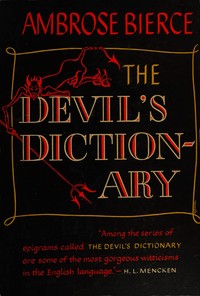
The Devil's Dictionary by Ambrose Bierce
Always visible content "The Devil's Dictionary" by Ambrose Bierce is a satirical dictionary written over three decades and published in complete form in 1911. This lexicon offers humorous and biting definitions of common words, transforming ordinary language into sharp social commentary. Originally appearing as magazine and newspaper installments beginning in the 1870s, Bierce's witty wordplay was widely imitated and plagiarized before being collected into book form. Now considered a masterpiece of American satire, it has Hidden checkbox to control the toggle Clickable label to show more The extra text that is initially hidden Clickable label to show less earned international acclaim for its brilliant, howlingly funny take on language and human nature. (This is an automatically generated summary.)