Featured Books
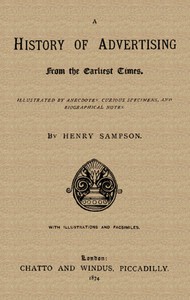
A History of Advertising from the Earliest Times. by Henry Sampson
Always visible content "A History of Advertising from the Earliest Times" by Henry Sampson is an extensive historical account written in the late 19th century. This work explores the development, significance, and evolution of advertising throughout history, illustrating its transformations and the various forms it has taken, from ancient times to the author's contemporary period. The book is likely to engage readers interested in the social and economic implications of advertising practices. The opening of Hidden checkbox to control the toggle Clickable label to show more The extra text that is initially hidden Clickable label to show less the text presents an overview of the book's intent and acknowledges the inherent challenges in documenting such a broad subject. Sampson notes that advertising is often mistakenly perceived as a modern invention, emphasizing its roots that can be traced back to ancient civilizations such as Greece and Rome. He begins to highlight different forms of advertising seen in old newspapers, showcasing how these advertisements reflect the life and culture of their times. The author aims to illustrate the development of advertising practices as integral to commerce and society, setting the stage for a deeper examination in subsequent chapters. (This is an automatically generated summary.)
One Thousand Ways to Make Money by Page Fox
Always visible content "One Thousand Ways to Make Money" by Page Fox is a practical guide to financial independence, written in the late 19th century. This extensive resource provides a wealth of ideas and strategies for earning income through various means, from starting a business to discovering unique opportunities for making money at home. With thorough insights and methods tailored for individuals seeking to improve their financial status, this book serves as a valuable tool Hidden checkbox to control the toggle Clickable label to show more The extra text that is initially hidden Clickable label to show less for anyone ambitious enough to pursue wealth. The opening portion of the book sets forth the author's intentions clearly: to assist those who are unemployed, underpaid, or simply seeking new avenues for income. Fox outlines how to secure a job or improve one's current employment situation while proposing numerous business strategies that can lead to success. The early chapters emphasize actionable steps such as understanding the importance of hard work, creative advertising techniques, and leveraging personal skills to generate revenue. Additionally, the author provides specific examples of successful individuals who rose from humble beginnings, illustrating that determination and innovation can lead to prosperity. Overall, the beginning of the book establishes a motivational tone, encouraging readers to apply these practical suggestions in their pursuit of financial growth. (This is an automatically generated summary.)
The History of the Standard Oil Company by Ida M. Tarbell
Always visible content "The History of the Standard Oil Company" by Ida M. Tarbell is an exposé published in 1904. Originally serialized in McClure's magazine, this groundbreaking work of investigative journalism reveals the monopolistic practices of John D. Rockefeller's Standard Oil empire. Through meticulous research and interviews with industry insiders, Tarbell uncovered evidence of price-rigging and predatory business tactics. Her revelations sparked public outrage and helped accelerate the company's eventual breakup in 1911, establishing a Hidden checkbox to control the toggle Clickable label to show more The extra text that is initially hidden Clickable label to show less landmark example of muckraking journalism's power to challenge corporate abuse. (This is an automatically generated summary.)

One Thousand Ways to Make a Living; or, An Encyclopædia of Plans to Make Money
Always visible content "One Thousand Ways to Make a Living; or, An Encyclopædia of Plans to Make Money" by Harold M. Dunphy is a practical guidebook written in the early 20th century. It compiles a diverse range of ideas and plans aimed at helping individuals find methods to earn a living, particularly in the context of post-World War I America. The book focuses on providing actionable, straightforward strategies for generating income, rather than offering vague Hidden checkbox to control the toggle Clickable label to show more The extra text that is initially hidden Clickable label to show less financial advice or "get-rich-quick" schemes. The opening portion of the book introduces the purpose and intention behind its creation, emphasizing its goal of empowering individuals, particularly those affected by unemployment post-war. It features a dedication to assisting those who have sacrificed for their country, as well as highlighting the importance of self-initiative. Furthermore, the text introduces several initial plans for making a living, showcasing inventive ideas like weaving baskets for ferns, becoming a professional hostess, or taking on creative ventures such as cooking and crafting—all of which demonstrate resourcefulness and adaptability. This serves as a foundation for the many strategies that will follow, inviting readers to explore new potential avenues to enhance their livelihoods. (This is an automatically generated summary.)
The Science of Getting Rich by W. D. Wattles
Always visible content "The Science of Getting Rich" by W. D. Wattles is a book published in 1910. Wattles presents what he calls the "Certain Way of Thinking," a mental technique rooted in New Thought philosophy that promises to unlock financial prosperity through positive mindset and self-affirmation rather than competition. The work applies mental healing strategies to wealth creation, offering seventeen chapters on overcoming mental barriers. Though widely regarded as pseudoscientific, it inspired later success Hidden checkbox to control the toggle Clickable label to show more The extra text that is initially hidden Clickable label to show less literature and Rhonda Byrne's "The Secret," remaining influential in personal development circles. (This is an automatically generated summary.)
The art of money getting : or, golden rules for making money by P. T. Barnum
Always visible content "The Art of Money Getting: or, Golden Rules for Making Money" by P.T. Barnum is a self-help book written in the late 19th century. This work offers practical advice on achieving financial success and highlights the importance of proper economic habits. Barnum, a renowned showman and entrepreneur, shares his insights based on personal experiences and observations, emphasizing values like hard work, frugality, and integrity. In the book, Barnum discusses essential principles for Hidden checkbox to control the toggle Clickable label to show more The extra text that is initially hidden Clickable label to show less making and retaining wealth. He emphasizes that true economy isn't merely about saving pennies but about ensuring that one's expenses are consistently lower than earnings. He encourages readers to avoid debt, choose vocations that align with their interests, and persist in their endeavors. Barnum’s anecdotes illustrate the pitfalls of extravagance and the significance of maintaining integrity in financial dealings. He asserts that a sound mind and good health are foundational to success, advocating for diligence, systematic work, and charitable behavior as key components of a prosperous life. Ultimately, Barnum’s work serves as a motivational guide for anyone seeking to improve their financial standing and make a lasting impact through honest work. (This is an automatically generated summary.)
Roman Stoicism by Edward Vernon Arnold
Always visible content "Roman Stoicism" by Edward Vernon Arnold is a scholarly examination of Stoic philosophy, particularly its development within the Roman Empire, written in the early 20th century. The text offers a thorough exploration of Stoicism's historical significance, philosophical doctrines, and its influence on later thought and religions. By framing Stoicism as a vital link between ancient and modern philosophies, Arnold emphasizes its relevance to contemporary discussions of morality and governance. The opening of Hidden checkbox to control the toggle Clickable label to show more The extra text that is initially hidden Clickable label to show less the work outlines the foundational premises of Stoicism and situates it within the broader context of world religions. Arnold begins by explaining how Roman literature reflects deep philosophical inquiries characteristic of the Stoics, particularly concerning fate, morality, and the nature of the divine. He highlights the importance of understanding the interplay between these philosophical questions and the socio-political landscape of the Roman world. The author sets the stage for a detailed exploration of the Stoic philosophy's evolution, its interaction with other religious and philosophical traditions like Judaism and Christianity, and its enduring legacy in Western thought. (This is an automatically generated summary.)
A Short History of Freethought Ancient and Modern, Volume 2 of 2 by J. M. Robertson
Always visible content "A Short History of Freethought Ancient and Modern, Volume 2 of 2" by J. M. Robertson is a historical account written in the early 20th century. The book explores the evolution of freethought through various significant periods and events, particularly focusing on England, Germany, France, and other European contexts from the Reformation through to the 19th century. This volume highlights the struggles, persecution, and intellectual developments surrounding the rise of rationalism and Hidden checkbox to control the toggle Clickable label to show more The extra text that is initially hidden Clickable label to show less secular thought in the face of prevailing religious dogmas. The opening portion of the work discusses the transition to modern freethought in England during a turbulent historical period that included the reigns of Henry VIII, Mary, and Elizabeth. It highlights the harsh penalties faced by those expressing heterodox beliefs, such as Anabaptists and Unitarians, emphasizing the severity of religious persecution. Additionally, the text documents various notable freethinkers from this era, their philosophical explorations, and the cultural conditions that fostered skepticism, as well as the tensions between belief and criticism within the literary and scientific communities of the time. This early discussion sets the stage for a broader examination of the development of freethought and rationalism across Europe in subsequent chapters. (This is an automatically generated summary.)
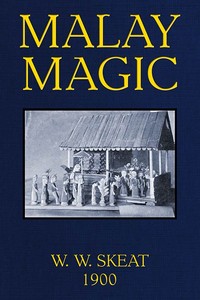
Malay Magic by Walter William Skeat
Always visible content "Malay Magic" by Walter William Skeat is an introductory work on folklore and popular religion written in the late 19th century. It explores the rich tapestry of beliefs, customs, and magical practices of the Malays in the Malay Peninsula, drawing upon a variety of sources, including personal observations, native manuscripts, and published works. The book aims to document and analyze the traditional beliefs and practices that are integral to Malay culture, highlighting Hidden checkbox to control the toggle Clickable label to show more The extra text that is initially hidden Clickable label to show less the complexity of their folklore intertwined with influences from Indian, Arab, and indigenous sources. The opening of the book sets the stage for a comprehensive exploration of Malay folklore, establishing the author's intent to create a representative account of Malay beliefs and magical practices. Skeat introduces the key themes such as creation myths, the understanding of nature, and the relationships between humans and the supernatural world. He reflects on the significance of various folkloric beliefs, such as the creation of the world and the role of magic in everyday life, and emphasizes the importance of these elements in understanding the Malay identity and culture. As he begins to unfold these narratives, the reader is invited into the intricate world of Malay magic, laying the foundation for the detailed studies that follow. (This is an automatically generated summary.)