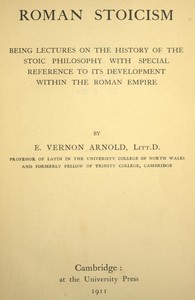
Roman Stoicism by Edward Vernon Arnold
Synopsis
Always visible content "Roman Stoicism" by Edward Vernon Arnold is a scholarly examination of Stoic philosophy, particularly its development within the Roman Empire, written in the early 20th century. The text offers a thorough exploration of Stoicism's historical significance, philosophical doctrines, and its influence on later thought and religions. By framing Stoicism as a vital link between ancient and modern philosophies, Arnold emphasizes its relevance to contemporary discussions of morality and governance. The opening of Hidden checkbox to control the toggle Clickable label to show more The extra text that is initially hidden Clickable label to show less the work outlines the foundational premises of Stoicism and situates it within the broader context of world religions. Arnold begins by explaining how Roman literature reflects deep philosophical inquiries characteristic of the Stoics, particularly concerning fate, morality, and the nature of the divine. He highlights the importance of understanding the interplay between these philosophical questions and the socio-political landscape of the Roman world. The author sets the stage for a detailed exploration of the Stoic philosophy's evolution, its interaction with other religious and philosophical traditions like Judaism and Christianity, and its enduring legacy in Western thought. (This is an automatically generated summary.)