Education_reference Books
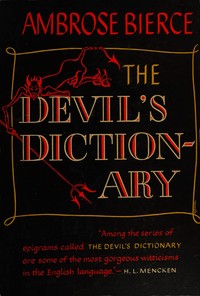
The Devil's Dictionary by Ambrose Bierce
Always visible content "The Devil's Dictionary" by Ambrose Bierce is a satirical dictionary written over three decades and published in complete form in 1911. This lexicon offers humorous and biting definitions of common words, transforming ordinary language into sharp social commentary. Originally appearing as magazine and newspaper installments beginning in the 1870s, Bierce's witty wordplay was widely imitated and plagiarized before being collected into book form. Now considered a masterpiece of American satire, it has Hidden checkbox to control the toggle Clickable label to show more The extra text that is initially hidden Clickable label to show less earned international acclaim for its brilliant, howlingly funny take on language and human nature. (This is an automatically generated summary.)

Encyclopaedia Britannica, 11th Edition, "Kelly, Edward" to "Kite" by Various
Always visible content "Encyclopaedia Britannica, 11th Edition, 'Kelly, Edward' to 'Kite'" by Various is a comprehensive reference work written in the late 19th century. This edition includes detailed articles on a wide variety of subjects, ranging from notable historical figures to geographical locations and scientific principles. The likely topic of this volume is the breadth of knowledge available during its time, emphasizing education and information dissemination. The opening of this particular volume features a series Hidden checkbox to control the toggle Clickable label to show more The extra text that is initially hidden Clickable label to show less of entries, starting with prominent individuals such as Edward Kelly, an Australian bushranger, followed by other notable figures and areas of interest like Sir Fitzroy Kelly, an English judge, and the town of Kelso in Scotland. It highlights their life stories, contributions, and relevance in history, presenting a rich tapestry of biographical and geographic insights that reflect the diverse knowledge encapsulated within the Encyclopaedia. This initial section establishes a foundation for understanding the expansive range of information presented in the subsequent articles. (This is an automatically generated summary.)

Encyclopaedia Britannica, 11th Edition, "Bent, James" to "Bibirine" by Various
Always visible content "Encyclopaedia Britannica, 11th Edition, 'Bent, James' to 'Bibirine'" by Various is a scientific publication written in the early 20th century. This work serves as a comprehensive reference resource, providing detailed entries on a multitude of topics including notable figures, historical events, scientific concepts, and geographical locations. The breadth of information suggests that it is a valuable tool for scholars, educators, and anyone seeking to expand their knowledge on a wide array of Hidden checkbox to control the toggle Clickable label to show more The extra text that is initially hidden Clickable label to show less subjects. At the start of this volume, readers are given an overview of notable individuals such as James Theodore Bent, an English traveler recognized for his extensive archaeological research and insights into ancient civilizations. The opening portion includes a series of transcriber's notes and corrections addressing typographical errors found in earlier entries, emphasizing the accuracy and attention to detail that characterize the Encyclopaedia's publication. In addition to entries on prominent figures, the content outlines various articles beginning with names that start with "Bent" and leading toward "Bibirine," indicating a structured and organized layout typical of encyclopedic works. (This is an automatically generated summary.)
Roget's Thesaurus by Peter Mark Roget
Always visible content "Roget's Thesaurus" by Peter Mark Roget is a reference work first published in 1852. Roget, a British physician and lexicographer, created this revolutionary system of verbal classification to help writers struggling with composition. Rather than arranging words alphabetically, his thesaurus organizes them into six primary classes with over a thousand meaning clusters, grouping words by semantic relationships and conceptual connections. Originally containing 15,000 words, the work has expanded through successive editions while Hidden checkbox to control the toggle Clickable label to show more The extra text that is initially hidden Clickable label to show less maintaining Roget's foundational organizational system, becoming one of the most widely used English-language reference tools. (This is an automatically generated summary.)
The Natural History of Pliny, Volume 1 (of 6) by the Elder Pliny
Always visible content "The Natural History of Pliny, Volume 1 (of 6)" by the Elder Pliny is an encyclopedic work published beginning in AD 77. The largest single work surviving from the Roman Empire, it compiles knowledge on an astonishing range of subjects—from astronomy and geography to zoology, botany, mining, and art. Pliny defines his scope as "the natural world, or life," presenting nature as a coherent whole serving humanity. Written at night while he Hidden checkbox to control the toggle Clickable label to show more The extra text that is initially hidden Clickable label to show less served Emperor Vespasian, this ambitious compilation became a model for all later encyclopedias. (This is an automatically generated summary.)

Putnam's Word Book by Louis A. Flemming
Always visible content "Putnam's Word Book" by Louis A. Flemming is a reference book on vocabulary and language usage, published during the early 20th century. This practical guide aims to assist readers in refining their expression through an extensive collection of synonyms, antonyms, and related words, which are invaluable for effective writing and speaking. The opening of "Putnam's Word Book" introduces the reader to the author's intentions, emphasizing that the book serves as a practical Hidden checkbox to control the toggle Clickable label to show more The extra text that is initially hidden Clickable label to show less resource for anyone looking to enhance their vocabulary. Flemming clarifies that the work does not dictate language usage but instead provides a comprehensive resource of words that can help express ideas with precision. Readers can expect to find well-structured entries that categorize words with similar meanings, opposite meanings, and associated terms, facilitating an exploration of nuanced language choices. Additionally, the preface highlights the importance of understanding the context in which each word may be used, thus offering a thoughtful approach to vocabulary development for both students and professionals across various fields. (This is an automatically generated summary.)
Modern English biography, volume 1 (of 4), A-H by Frederic Boase
Always visible content "Modern English Biography, Volume 1 (of 4), A-H" by Frederic Boase is a biographical reference work written in the late 19th century. This volume contains concise memoirs of notable individuals who have died since 1850, including various public figures such as politicians, artists, and professionals from a wide range of fields. The purpose of the book is to provide a comprehensive overview of these individuals, offering factual accounts and significant details that Hidden checkbox to control the toggle Clickable label to show more The extra text that is initially hidden Clickable label to show less may not be found in other biographical works. The opening portion of the book introduces the author’s motivation for compiling these biographies, explaining the historical evolution and fluctuations of interest in the genre. Boase emphasizes the growing need for a structured format to cover the vast subject of biography, especially since previous works had limitations in scope. His approach includes an alphabetical arrangement of entries and highlights diverse individuals—ranging from privy councillors and bishops to eccentric characters and notorious criminals—ensuring that even lesser-known figures receive recognition. The preface sets the stage for what readers can expect from the detailed memoirs that follow, establishing the significance of personal histories within the broader context of English biography. (This is an automatically generated summary.)
The Roll of Honour, Volume 1 : A biographical record of all members of His…
Always visible content "The Roll of Honour, Volume 1: A Biographical Record of All Members of His Majesty’s Naval and Military Forces Who Have Fallen in the War" by the Marquis de Ruvigny is a historical reference work written in the early 20th century. This volume is an extensive biographical register dedicated to British and Commonwealth soldiers, sailors, and officers who lost their lives during a major conflict, almost certainly the First World War. The Hidden checkbox to control the toggle Clickable label to show more The extra text that is initially hidden Clickable label to show less book collects and preserves individual stories and service details, providing not only names and ranks but also personal backgrounds and circumstances of death. Its primary aim is to offer permanent tribute and remembrance for the fallen, ensuring their sacrifices are not forgotten by future generations. The opening of this volume sets a solemn, respectful tone, with introductory remarks that reflect on the significance of the war and the lasting debt owed to those who died. The editor emphasizes that history’s judgment on the war’s causes and conduct will come in time, but that the nobility of those who gave their lives stands above interpretation. The preface thoroughly explains the methodical approach to the compilation: biographies are arranged alphabetically, and details such as parentage, education, careers, military service, and, where possible, excerpts from letters are included. The first entries themselves provide poignant, individualized portraits—concise yet personal—of servicemen from a wide array of backgrounds, each record honoring their life, military service, and ultimate sacrifice. (This is an automatically generated summary.)
The Elements of Style by William Strunk
Always visible content "The Elements of Style" by William Strunk is a style guide first published in 1920. This compact manual distills the essentials of clear English prose into rules about grammar, punctuation, composition, and word usage. Strunk's original "little book" urged writers to omit needless words and embrace brevity. Later enlarged by his former student E. B. White in 1959, it became the influential writing guide known as "Strunk & White," selling millions of Hidden checkbox to control the toggle Clickable label to show more The extra text that is initially hidden Clickable label to show less copies and shaping generations of American writers with its prescriptive approach to craft. (This is an automatically generated summary.)